
Commercial Gas Ranges by Industry: Which Configuration Fits Your Kitchen?
Pizzerias, steakhouses, and hotel kitchens each demand different burner counts, BTU outputs, and deck depths. This guide walks you through seven sectors.
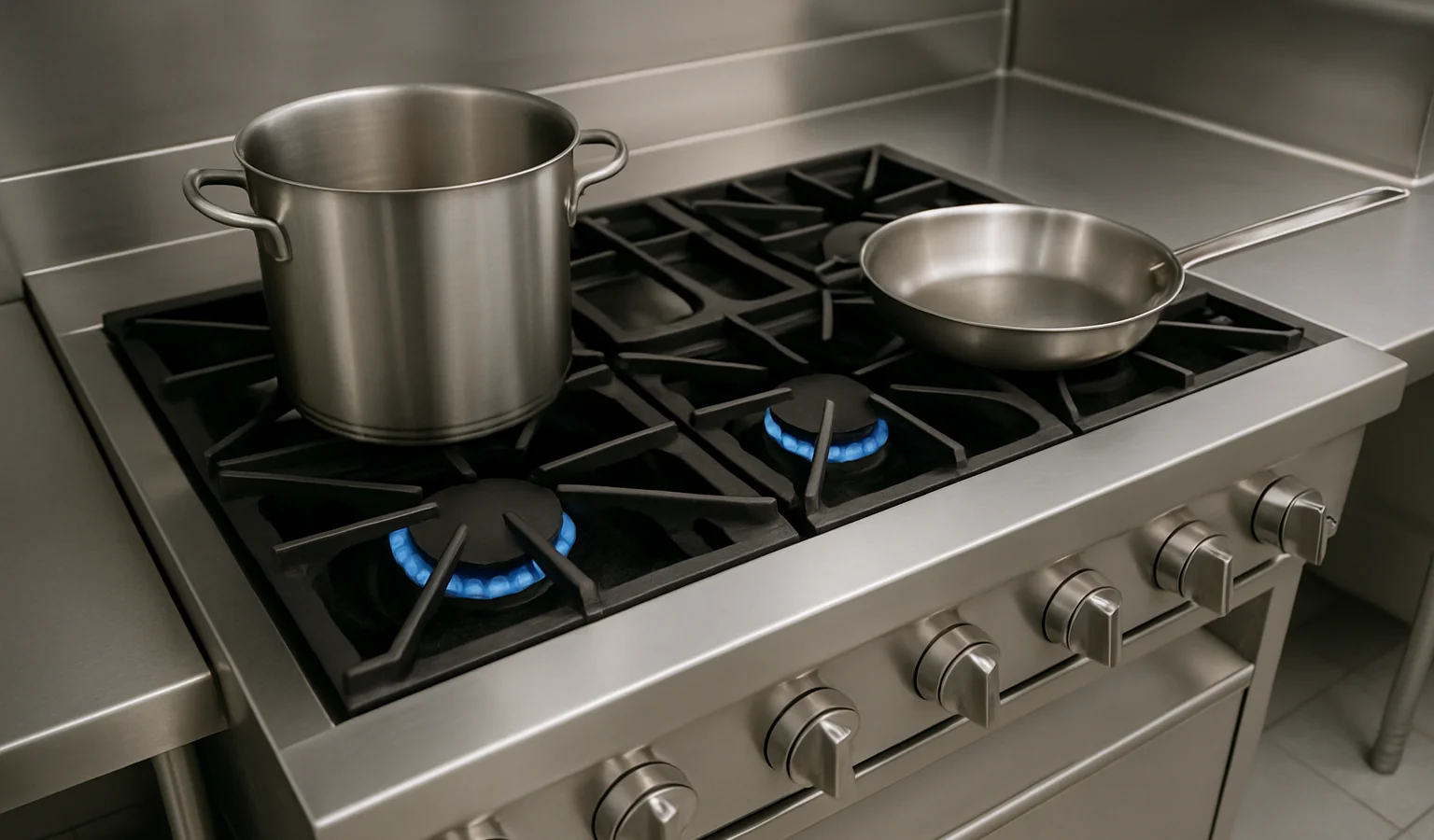
Matching Equipment to Kitchen Workflows
A six-burner range that works for a bistro can bottleneck a hotel banquet kitchen. BTU output, burner count, and deck depth are not arbitrary specifications — they map directly to menu complexity, average ticket time, and peak-hour volume. Buyers shopping for Commercial Kitchen Equipment often default to a mid-range model, then discover mid-service that they lack the capacity or the precise heat control their menu requires.
This article breaks down commercial gas range configurations across seven common foodservice sectors: pizzeria, steakhouse, hotel kitchen, cloud kitchen, catering operation, café or bistro, and institutional kitchen. For each, you will see typical requirements (BTU range, burner count, deck depth), the recommended product type, and one practical tip drawn from industry best practice. The final section covers what to verify when sourcing restaurant kitchen equipment from Turkey, including CE marking and material specifications.
Pizzeria: High-BTU Front Burners and Oven Proximity
Typical needs: 25 000–30 000 BTU front burners, four to six burners, standard 800 mm depth.
Recommended product type: Open-burner range with a griddle plate or charbroiler attachment on one side. Many pizzerias run a dedicated pizza oven and use the range for sauces, sautés, and side dishes. High front-burner output supports rapid reduction of tomato sauce and fast searing of proteins for pasta toppings.
Practical tip: Position the range within two metres of the pizza oven where layout allows. Line cooks move constantly between sauce pots and oven peels; reducing that distance by even one step per ticket adds up over a dinner shift. If space is tight, a four-burner unit with two high-output burners (front left and front right) gives you flexibility without occupying the footprint of a six-burner model.
Steakhouse: Heavy-Duty Grates and Infrared Broiler Integration
Typical needs: 30 000–35 000 BTU per burner, six burners minimum, 900 mm depth to accommodate large stockpots.
Recommended product type: Heavy-duty open-burner range with cast-iron grates rated for continuous use. Steakhouses benefit from a range that sits adjacent to or incorporates an overhead infrared salamander broiler. The range handles sides (mashed potatoes, sautéed vegetables, béarnaise) while the broiler finishes steaks.
Practical tip: Verify grate weight and material before purchase. Thin stamped-steel grates can warp under the sustained high heat of a steakhouse line. Cast-iron grates that weigh roughly 8–10 kg per section stay flat, distribute heat evenly, and tolerate the constant on-off cycle of searing pans. Cast-iron grates typically cost more upfront, but replacement frequency tends to drop significantly over multi-year service.
Hotel Kitchen: Modular Ranges and Dual Fuel Options
Typical needs: 28 000–32 000 BTU per burner, eight to twelve burners across modular sections, 900–1 000 mm depth for banquet-sized stockpots.
Recommended product type: Modular suite of ranges — typically two four-burner or six-burner sections placed side by side, sometimes paired with an electric convection oven base. Hotel kitchens serve breakfast, lunch, dinner, and banquets simultaneously; modular design lets you allocate one section to breakfast (pancakes, omelettes) and another to banquet prep (bulk soups, risotto).
Practical tip: Choose units with individual shut-off valves for each burner. During low-occupancy periods, you can disable half the burners to reduce gas consumption and lower ventilation load. Hotel operators commonly report meaningful energy savings in shoulder seasons by running a smaller section instead of the full burner line.
When planning a hotel kitchen layout, consider both Gas Cooking Equipment and Electric Cooking Equipment to balance installation cost, utility rates, and menu requirements.
Cloud Kitchen: Compact Footprint and Easy Cleaning
Typical needs: 20 000–25 000 BTU per burner, four burners, 700–800 mm depth, stainless-steel splash guard.
Recommended product type: Compact four-burner range with a narrow profile (600 mm width is common). Cloud kitchens operate multiple brands from a single space; equipment must be simple to clean between brand switches and fit into tight linear layouts. Sealed burners reduce the chance of spills reaching the gas manifold.
Practical tip: Prioritise ranges with removable drip trays and front-access gas valves. Cloud-kitchen staff turn over frequently, and maintenance tasks must be foolproof. A drip tray that slides out from the front (no need to lift grates) shortens cleaning time considerably and supports compliance during health inspections. Front-access valves let a technician service one burner without shutting down the entire line.
Catering: Portability and Rapid Heat Recovery
Typical needs: 28 000–30 000 BTU per burner, four to six burners, 800 mm depth, optional caster kit.
Recommended product type: Mobile range on locking casters with a quick-disconnect gas hose. Caterers often set up in venues without fixed equipment; a mobile range that connects to a standard LPG cylinder gives you flexibility. Look for models with wind guards if you expect any outdoor use.
Practical tip: Test heat-recovery time before committing to a model. Catering workflows involve batch cooking — searing fifty chicken breasts in sequence, or reducing ten litres of stock. A burner that returns to full temperature quickly after a cold pan is added maintains throughput; a slow-recovery burner creates a queue. Manufacturers rarely publish recovery specs, so request a live demonstration or a trial period.
Café and Bistro: Aesthetic Finish and Moderate Output
Typical needs: 18 000–22 000 BTU per burner, four burners, 700–800 mm depth, visible stainless or matte-black finish if the range is front-of-house.
Recommended product type: Sealed-burner range with a cleanable cooktop and minimal crevices. Cafés often feature open kitchens; the range becomes part of the dining-room aesthetic. Sealed burners contain spills on the cooktop surface, simplifying wipe-down between service periods.
Practical tip: Match burner output to your menu intensity. A café serving panini, soup, and espresso drinks does not need the same BTU as a steakhouse. Oversized burners waste gas and generate excess heat, forcing your HVAC system to work harder. A four-burner unit with two higher-output burners and two simmer burners covers most café menus and keeps the kitchen comfortable for front-of-house staff working nearby.
Institutional Kitchen: Durability and Safety Interlocks
Typical needs: 25 000–28 000 BTU per burner, six to ten burners, 900 mm depth, flame-failure safety devices.
Recommended product type: Heavy-duty open-burner range with flame-failure sensors and pilot-light monitoring. Institutional kitchens (schools, hospitals, military bases) operate under strict safety codes and serve high volumes with staff who may have varied skill levels. Flame-failure devices shut off gas flow if a burner flame extinguishes, preventing gas accumulation.
Practical tip: Specify ranges that meet the relevant EN 203 series safety standards or equivalent regional regulations. Institutional procurement often requires third-party certification; a range without CE marking or a test report from a notified body will stall your tender process. Models with integrated safety interlocks, timers, and audible alarms typically carry a price premium that is justified by reduced liability and alignment with occupational health regulations in most jurisdictions.
For high-volume institutional or hotel banquet operations, Heavy Cooking Equipment categories include tilt skillets and braising pans that complement range capacity.
Key Specifications to Compare Across Models
When evaluating commercial gas ranges for any sector, verify the following specifications in the technical datasheet:
- Burner BTU output: Measured in BTU per hour (BTU/h) or kilowatts (kW). Confirm that at least two burners meet your peak-heat requirements.
- Burner count and layout: Four-burner, six-burner, or modular eight-burner configurations. Check burner spacing — 300 mm centres allow two large stockpots side by side without crowding.
- Deck depth: Standard is 800 mm; heavy-duty models extend to 900–1 000 mm to accommodate 50-litre stockpots.
- Material and finish: AISI 304 stainless steel is the typical specification for commercial durability. AISI 430 is common in budget models but is less corrosion-resistant in humid or high-salinity environments.
- Grate type: Cast iron for heavy use, stamped steel for light-duty. Removable grates simplify cleaning.
- Oven base option: Many ranges offer a convection oven, static oven, or open cabinet base. Match this to your workflow — a convection oven base adds baking capacity but raises the cooking surface by 150–200 mm.
- Gas input and connection: Confirm natural gas (NG) or liquefied petroleum gas (LPG) compatibility. Orifice kits for dual-fuel conversion are often available as an option.
- Ignition type: Pilot light (continuous), piezo manual ignition, or electronic ignition. Electronic ignition reduces gas consumption but requires a mains power connection.
- Certifications: CE marking for European markets, NSF or ETL for North America. Some buyers require ISO 9001 certification from the manufacturer.
Sizing the Range to Kitchen Volume
A common sizing error is matching burner count to menu items rather than to ticket volume. A bistro with a twelve-item menu may need only four burners if average ticket time is eight minutes and peak volume is thirty covers per hour. A hotel kitchen with a six-item banquet menu may need ten burners if it must plate two hundred covers in ninety minutes.
A rough guideline used in capacity planning: one burner typically supports 8–12 covers per hour for cooked-to-order dishes (omelettes, sautés, risotto) or 15–20 covers per hour for batch-cooked items (soups, sauces, pasta). Adding 20 per cent headroom for peak periods and equipment downtime is a common practice. These figures are indicative only — actual capacity depends on menu, staffing, and kitchen layout, so validate with your operations team.
For example, a cloud kitchen targeting 120 lunch orders per hour across three virtual brands, with an average of two cooked items per order (240 items per hour), would require approximately 240 ÷ 12 = 20 burner-hours of capacity. Spreading this across a two-hour lunch peak gives you ten burners minimum. In practice, a modular setup with two six-burner ranges provides flexibility and redundancy.
Sourcing Restaurant Kitchen Equipment from Turkey
Turkey is a significant producer of commercial kitchen equipment, with established manufacturing activity in several regions. When sourcing a commercial gas range from a Turkish supplier, prioritise these verification steps:
CE marking and EN standards: The EU–Turkey customs union framework requires Turkish manufacturers exporting to EU markets to meet CE marking obligations. For commercial gas ranges, the relevant standards belong to the EN 203 series (covering safety and energy efficiency for gas-heated catering appliances). Request a copy of the EU Declaration of Conformity and the test report from a notified body. If the supplier cannot provide these documents, the unit may not clear customs in EU member states.
Material specification — AISI 304 vs AISI 430: AISI 304 stainless steel offers superior corrosion resistance and weldability compared with AISI 430, which is less expensive and adequate for dry indoor environments but more prone to rust in coastal or high-humidity kitchens. Verify the material grade in the technical specification and request a mill certificate if the order volume justifies it. A modest price difference between AISI 430 and AISI 304 is typical; the durability gain often justifies the cost in commercial applications.
Burner and valve components: Many European buyers specify burner assemblies and gas valves from established European component manufacturers. Turkish range manufacturers may use domestically produced components to reduce cost; confirm component origin and quality for critical parts. A nameplate burner rated at high BTU but paired with lower-quality valves may deliver inconsistent flame or shorten service life.
Factory acceptance test (FAT): For orders above ten units, request a factory acceptance test before shipment. A typical FAT includes ignition cycle testing (multiple consecutive ignitions), flame stability under simulated wind load, gas-leak testing at all connections, and a full-load burn to verify BTU output and surface temperature. Document the test with photographs and a signed report.
Incoterms and shipping: Most Turkish suppliers quote FOB (Free On Board) from a major Turkish export port. Approximate transit times — subject to carrier, routing, and current shipping conditions — are roughly two weeks to Western European ports, longer to UK ports, and three to four weeks to North American East Coast ports. CIF (Cost, Insurance, and Freight) terms shift insurance responsibility to the seller, simplifying your logistics but reducing control over carrier selection. For high-value shipments, consider EXW (Ex Works) and arrange your own freight forwarder to ensure proper crating and container loading.
Spare parts and technical support: Confirm that the supplier stocks spare parts (burner heads, grates, igniters, thermocouples) and provides English-language technical manuals. A common complaint among importers is that a manufacturer ships equipment quickly but takes weeks to air-freight a replacement part. Negotiate a spare-parts kit (commonly priced as a small percentage of order value) to be included in the main shipment, covering the most frequently replaced components.
Common Pitfalls When Specifying Commercial Ranges
Underestimating ventilation requirements: A six-burner range operating at full output produces a substantial heat load. Your kitchen hood and makeup air system must match that load. Verify the CFM (cubic feet per minute) rating of your hood against the range's BTU output; inadequate ventilation leads to heat buildup, grease accumulation, and fire-code violations. A licensed HVAC engineer should sign off on this calculation.
Ignoring floor loading: A heavy-duty range with a convection oven base and cast-iron grates can weigh several hundred kilograms when fully assembled. If your kitchen is on an upper floor or a raised platform, confirm that the floor structure supports the point load. A structural engineer can confirm whether you need to reinforce the subfloor or install load-spreading plates.
Overlooking gas-pressure requirements: Commercial burners require higher gas pressure than residential lines typically deliver. You may need a pressure regulator or a dedicated gas line from the meter to the range. Budget for a licensed gas fitter to inspect and certify the installation according to local codes.
Neglecting operator training: A range with electronic ignition and flame-failure interlocks is safer but requires staff to understand the control sequence. If a burner fails to light, an untrained operator may bypass the safety device or flood the firebox with gas. Include operator training in your purchase agreement, either on-site or via video call, covering startup, shutdown, daily cleaning, and troubleshooting.
Maintenance Schedule for Longevity
A well-maintained commercial gas range typically delivers many years of continuous service. A general maintenance cadence:
Daily: Remove and clean grates and burner caps. Wipe cooktop surface. Check for gas odours and inspect hose connections for kinks.
Weekly: Degrease the area around burners and pilot lights. Inspect flame colour (blue indicates complete combustion; yellow or orange may indicate an air-mixture adjustment is needed). Test ignition on all burners.
Monthly: Remove burner heads and clean orifices with a brass wire brush. Check gas-valve operation (smooth turn, no sticking). Inspect oven door seals if the range has an oven base.
Quarterly: Schedule a licensed technician to perform a combustion analysis, check for gas leaks with soapy water or a detector, verify flame-failure device operation, and lubricate valve stems. Replace any worn gaskets or igniters.
Annually: Replace burner orifices if they show corrosion. Recalibrate oven thermostats. Inspect and tighten all gas fittings. Update maintenance log for insurance and health-department records.
Making the Final Decision
Your sector and menu drive the configuration. A pizzeria typically thrives with a compact four-burner unit and high front-burner BTU; a hotel banquet kitchen often requires modular eight- or twelve-burner sections with easy zone control. Request datasheets from at least three manufacturers, compare material grades (AISI 304 is the standard most buyers expect), and verify that CE marking or equivalent certification is in place before you issue a purchase order.
When sourcing from Turkey, the combination of competitive pricing, EN-standard compliance, and proximity to European markets makes Turkish manufacturers a practical choice for many buyers. Confirm material specifications in writing, request a factory acceptance test for larger orders, and negotiate spare-parts inclusion to avoid delays once the equipment is in service.
ExportSync connects international buyers with verified Turkish manufacturers of commercial cooking equipment. Submit your specifications — burner count, BTU requirements, certifications needed — and receive tailored quotations from suppliers with documented production capacity and compliance records. Start your sourcing request today to compare offers and lead times.